Make the next turn clear.
Arrival, sightlines and landmarks that help people understand a place before reading a sign.
Start a project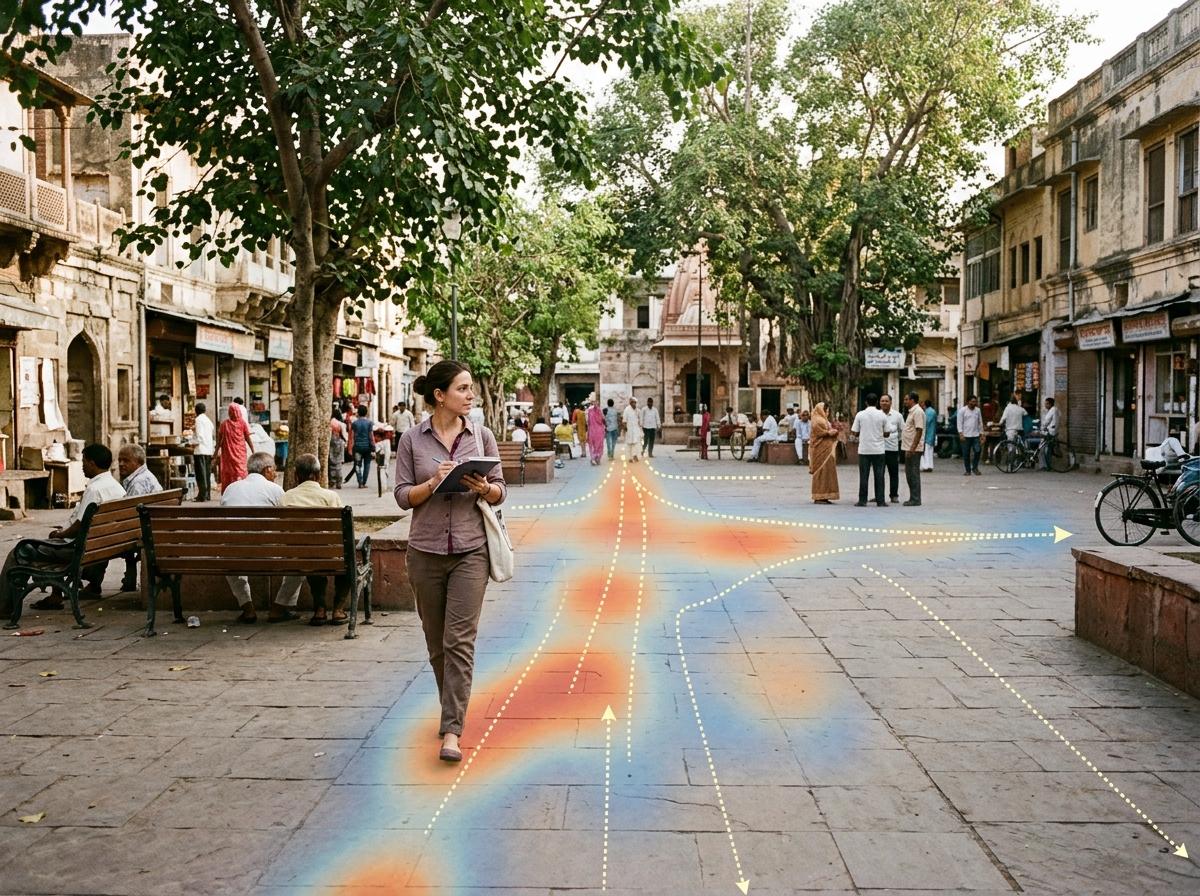
Read the place before the signs.
A sign cannot fully compensate for a hidden entrance or a confusing junction. We review the environmental clues people use: approach, sightlines, landmarks, transitions and visible destinations. Observation reveals where visitors hesitate or repeatedly ask for help.
- 1
Arrive
Recognize the entrance and the first destination.
- 2
Orient
See a landmark or understandable spatial hierarchy.
- 3
Decide
Read the junction before committing to a route.
- 4
Reach
Confirm the destination without doubling back.
Clarity comes from coordinated cues.
A wayfinding consultant improves more than signage. Happy Spaces reviews the spatial clues people use to understand a place, including arrival, sightlines, landmarks, zoning, thresholds, lighting, contrast, routes, and pause points.
Arrival and orientation review
Assess approach, entry recognition, first decisions, waiting, and the visibility of key destinations.
Route and decision-point review
Study sightlines, junctions, vertical movement, landmarks, and moments where people hesitate.
Environmental cue strategy
Use zoning, light, contrast, material, identity, and spatial hierarchy to support understanding.
User-specific experience review
Consider guests, older adults, residents, employees, visitors, staff, and people with different abilities.
Different people need different clues.
For hotels, senior living communities, workplaces, residential developments, and mixed-use projects where movement shapes confidence and trust.
Concept planning, design development, signage coordination, pre-opening review, and existing-place improvement.
Wayfinding and experience reviews are available across India and international project locations.
Confidence, not dependence.
Consider first-time visitors, guests, older adults, staff and people with different abilities. Familiarity for one user does not mean clarity for everyone.
Before we begin.
Yes. People understand places through routes, sightlines, landmarks, thresholds, light, contrast, zoning, and visible destinations before they read a sign.
Early planning offers the greatest opportunity to improve legibility. Design development, signage coordination, and existing-space audits can also solve important problems.
Yes. The work can focus on cognitive legibility, confidence, independence, familiar cues, glare, route length, landmarks, and safe movement.
Yes. Observation can identify hesitation points, repeated questions, hidden destinations, difficult transitions, and environmental cues that need strengthening.
Show us where people hesitate.
Arrival, sightlines and landmarks that help people understand a place before reading a sign.
We will discuss the brief, scope and working format before confirming an engagement.
 Made with Levo