Aug 4, 2026 · 9 min read
How Wayfinding Changes Confidence and Independence
Wayfinding is not just about helping people get from one place to another. It shapes whether residents, guests, patients, and employees feel calm, capable, and able to move through a space without asking for help.
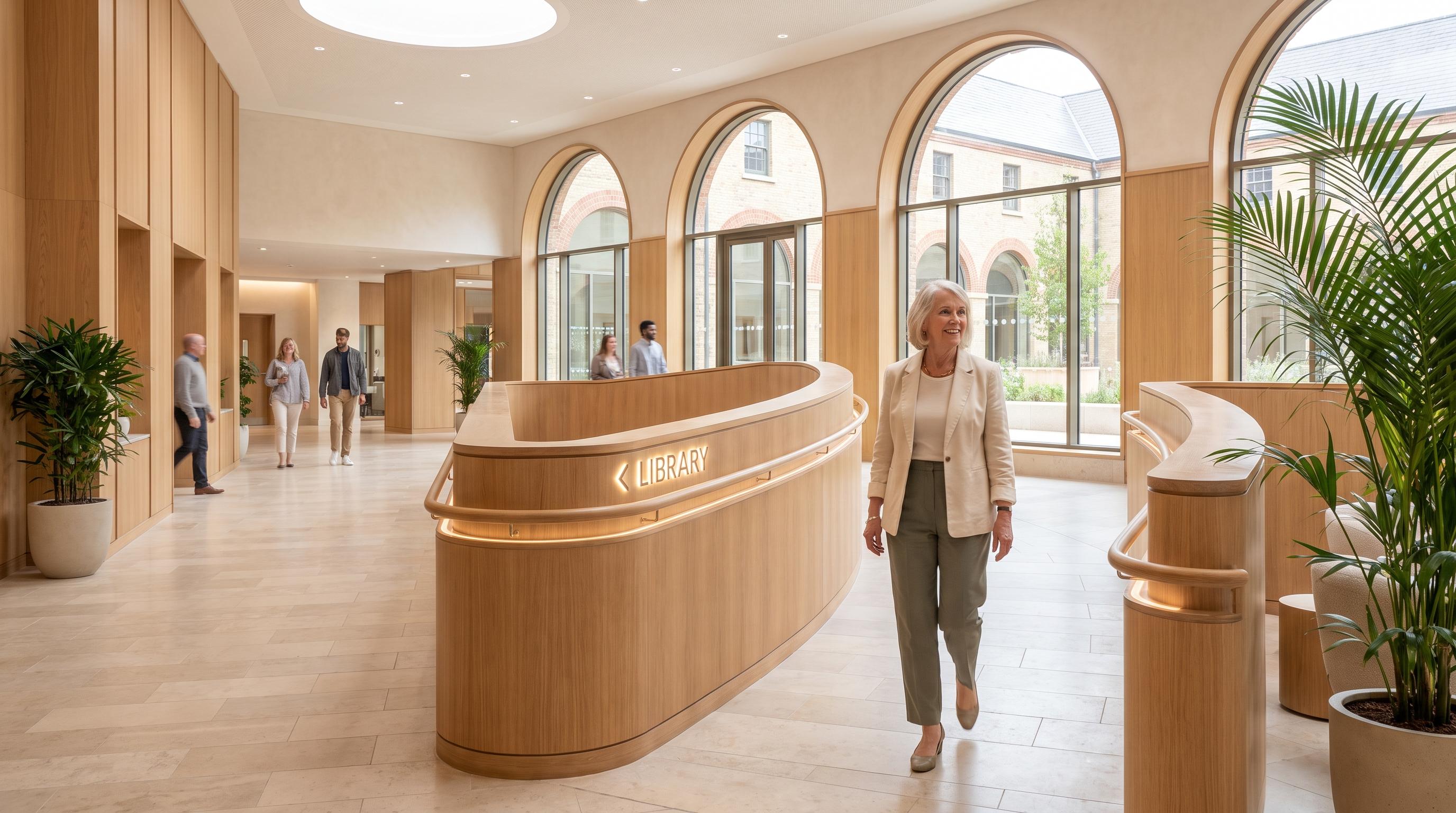
Wayfinding is an emotional experience, not just a directional one
Wayfinding shapes how capable people feel inside a building. When movement is intuitive, destinations are visible, and choices make sense, people stay calmer and act more independently. When circulation is confusing, every wrong turn quietly increases hesitation, dependence, and stress.
That is why wayfinding should not be treated as a late-stage signage package. It begins with planning, sightlines, landmarks, thresholds, lighting, and the legibility of the layout itself. A person should be able to understand where they are, where they need to go, and what will happen next without constantly asking for help.
In commercial terms, this matters more than many teams realise. Better wayfinding improves guest ease in hotels, supports dignity in senior living, reduces friction in workplaces, and strengthens the everyday experience of residential projects. It changes how a space performs because it changes how people feel while using it.
In short: clear wayfinding reduces uncertainty.
Reduced uncertainty supports confidence.
Confidence supports independence. That is why legible movement is a design priority, not a finishing touch.
Why wayfinding affects confidence so directly
Confidence drops quickly when a person cannot read a space. Most people do not describe the problem as “poor wayfinding.” They say the place feels stressful, tiring, awkward, or harder to use than it should be.
Where to turn
Whether they are in the right zone
Which door is theirs
Whether the lift leads where they expect
How easily they can find the toilet, lounge, reception desk, or exit again
A hotel guest arriving late at night
An older adult navigating a new community
A family visiting senior living for the first time
A visitor entering a large mixed-use development
In each case, the environment should do some of the cognitive work before staff step in.
Independence depends on what the environment makes easy
Independence is easier to preserve when the environment reduces avoidable effort. People stay more self-sufficient when they can reach everyday destinations without repeated instructions, embarrassment, or fear of getting lost.
A 2022 study of long-term care communities found that residents face greater risk of reduced engagement and loss of independence when wayfinding is weak. The review showed recurring problems such as long corridors, low visual connectedness, weak lighting, and too few directional signs at decision points. That finding matters beyond care settings because it points to the same underlying truth: when buildings are hard to read, people become more dependent on others.
Guidance from Victoria’s dementia-friendly environment resources makes a similar point in practical terms. Wayfinding supports independent movement when key places are easy to see, landmarks are memorable, signs are simple, contrast is strong, and rooms clearly signal their purpose. These are not decorative decisions. They directly shape whether a person moves with ease or hesitation.
What poor wayfinding looks like in real projects
Poor wayfinding is usually visible long before anyone names it as a design problem. The signals often appear in behaviour first.
Visitors stop to ask for help at obvious decision points.
Guests arrive at a destination slightly tense rather than settled.
Residents avoid routes that feel confusing, exposed, or tiring.
Staff spend time giving directions that the building should have handled.
Families judge a place as less reassuring because it feels hard to read.
People stick to one familiar path instead of using the full environment confidently.
These signs are easy to overlook because each one seems small. Together, they reveal that the space is asking too much from the user. That extra effort is exactly what weakens confidence and independence over time.
What strong wayfinding does instead
Strong wayfinding reduces mental load from the first few minutes of use. A person should be able to orient themselves quickly, recognise landmarks, predict where routes lead, and recover easily if they make a wrong turn.
Most generic wayfinding advice starts with signage. Stronger projects start earlier: plan configuration, sightlines, and destination visibility should do the first layer of work before signage has to rescue the layout. That is what moves wayfinding from a graphic add-on into a spatial design decision.
They walk with less hesitation.
They ask fewer questions.
They are more willing to explore.
They return to shared spaces on their own more easily.
The building feels helpful rather than testing.
The design moves that change confidence and independence
The most effective wayfinding systems are built into the environment, not pasted on top of it. These are the design moves that make the biggest difference.
1. Clear sightlines
People feel more confident when they can see where a route leads. Visible reception desks, lounges, courtyards, lifts, and exits reduce guesswork and make movement feel safer.
2. Distinct landmarks
Landmarks help people form a mental map. A particular tree, artwork, colour zone, light feature, or seating nook can make a route easier to remember than a corridor that looks identical from end to end.
3. Legible decision points
Intersections, lift lobbies, and major thresholds should explain the next choice immediately. If people have to stop, scan, and decode every junction, the layout is carrying too much friction.
4. Simple naming and signage
Signs work best when the language is plain, contrast is strong, and placement matches the moment of decision. Long labels, weak contrast, and signs that appear too early or too late create more stress instead of less.
5. Lighting that supports orientation
Lighting should help people understand routes, destination zones, and transitions in importance. Dim or inconsistent lighting weakens confidence, especially for older adults and first-time visitors.
6. Predictable zoning
People move more independently when quiet spaces, social areas, amenities, and service zones follow an understandable logic. A building feels easier to use when activities are where users expect them to be.
Why this matters so much in senior living
Wayfinding is especially critical in senior living because confidence and independence are part of the offer itself. A community feels more dignified when residents can move through it with less reliance on staff or family guidance.
That does not mean the environment must feel clinical. In fact, the opposite is usually true. The best senior living environments use warm landmarks, meaningful cues, visible shared destinations, restful pauses, and intuitive routes to support movement without making support feel obvious or institutional.
When families visit a senior living project, they read this almost immediately. If the building feels legible, calm, and easy to navigate, they infer that daily life may feel safer and kinder too. If circulation feels repetitive, dim, or confusing, confidence falls even before anyone has assessed the care model in detail.
Why hospitality projects should care too
Wayfinding directly affects guest experience because confusion interrupts arrival, comfort, and emotional ease. A hotel can look premium and still feel harder to use than it should if routes are unclear or destinations are not intuitive.
Guests remember whether they found their room easily, whether the spa or restaurant felt discoverable, whether public areas made sense on first use, and whether they felt awkward asking for directions repeatedly. Better wayfinding supports the emotional quality of a stay because it reduces friction at exactly the moments when guests want to feel settled, welcomed, and in control.
This is one reason hospitality design should treat wayfinding as part of placemaking. Signage matters, but the deeper issue is whether the whole arrival and movement sequence feels obvious in a calm, premium way.
Why workplaces and residential projects benefit too
Wayfinding matters in offices because friction affects confidence at work. Employees and visitors lose time and mental energy when meeting rooms are hard to find, circulation is ambiguous, or floors have no memorable identity.
It matters in residential projects because people judge a development by how easily daily life unfolds. Entry sequence, lift lobby logic, clubhouse access, parking transitions, and shared amenity routes all shape whether the project feels thoughtful or tiring. The easier it is to understand, the more secure and capable people feel using it.
That is why movement and wayfinding belong alongside acoustics, comfort, and arrival in any serious wellbeing-led review. These are not separate concerns. Together, they shape whether a place feels friction-heavy or confidence-building.
How this connects to the Happy Spaces framework
Wayfinding sits across several pillars at once because movement affects more than orientation. It changes how a space feels emotionally and socially.
Barriers: poor legibility creates friction, confusion, and fatigue.
Safety: intuitive circulation increases confidence and perceived security.
Belongingness: people feel more welcome when they can understand how to use a place.
Reward: movement can feel calm, graceful, and even memorable when routes are well handled.
This is why wayfinding should not be reduced to arrows on walls. It is part of how a building communicates care. It tells people whether they are expected to cope alone, depend on others, or move through the space with quiet confidence.
Questions worth asking in a design review
A stronger design review looks at movement from the user’s point of view, not only from the plan. These questions usually reveal whether a project is supporting confidence and independence.
Can a first-time visitor understand the main route without explanation?
Are key destinations visible when they need to be?
Do decision points feel obvious or mentally tiring?
Would an older adult feel comfortable navigating this path alone?
Do lighting, contrast, and landmarks help the route stay memorable?
Is the building relying on staff directions to compensate for layout problems?
Reviewing a project now? Explore the Happy Space Framework to assess confidence, comfort, and legibility across the five pillars, or browse Places to see the wider design levers that shape movement and ease.
The real outcome is not navigation alone
Better wayfinding does more than help people reach a destination. It helps them feel equal to the environment. That shift is what changes confidence and independence.
When a person can move through a place without repeated help, they feel more capable. When they can predict what comes next, they feel safer. When they can recognise where they are and return there easily, they feel more at home. Those outcomes matter in senior living, hospitality, workplaces, and residential projects because they affect lived experience every single day.
Easy to understand is part of premium. If a space is meant to feel dignified or genuinely supportive, legibility cannot be treated as optional.
Frequently asked questions
Why does wayfinding affect confidence so much?
Because movement through a building is full of small decisions. When those decisions are easy, people feel calm and capable. When the environment is hard to read, hesitation builds quickly and the space feels more stressful than supportive.
Is wayfinding only about signage?
No. Signage is only one part of it. Layout, sightlines, landmarks, lighting, naming, and the visibility of destinations all shape whether people can understand a place without effort.
Why is wayfinding especially important in senior living?
Because it directly affects dignity, ease, and independence. A more legible environment helps residents reach everyday destinations with less reliance on staff or family guidance, and it gives families more confidence in the setting too.
Can better wayfinding help hotels and workplaces as well?
Yes. In hotels, it reduces guest stress and improves the emotional quality of arrival and stay. In workplaces, it lowers friction, saves time, and helps employees and visitors use the environment more confidently.
Key takeaways
Clear wayfinding reduces uncertainty before people ask for help.
Confidence grows when routes, landmarks, and decision points make sense quickly.
Independence depends on layout, sightlines, lighting, and naming, not signage alone.
Senior living, hotels, workplaces, and residential projects all benefit from more legible movement.
The strongest wayfinding works in the planning stage, before signs need to compensate.