Aug 4, 2026 · 9 min read
Designing Workplaces People Can Actually Work Well In
A high-performing workplace is not just stylish or collaborative. It helps people focus, recover, connect, and do better work with less friction.
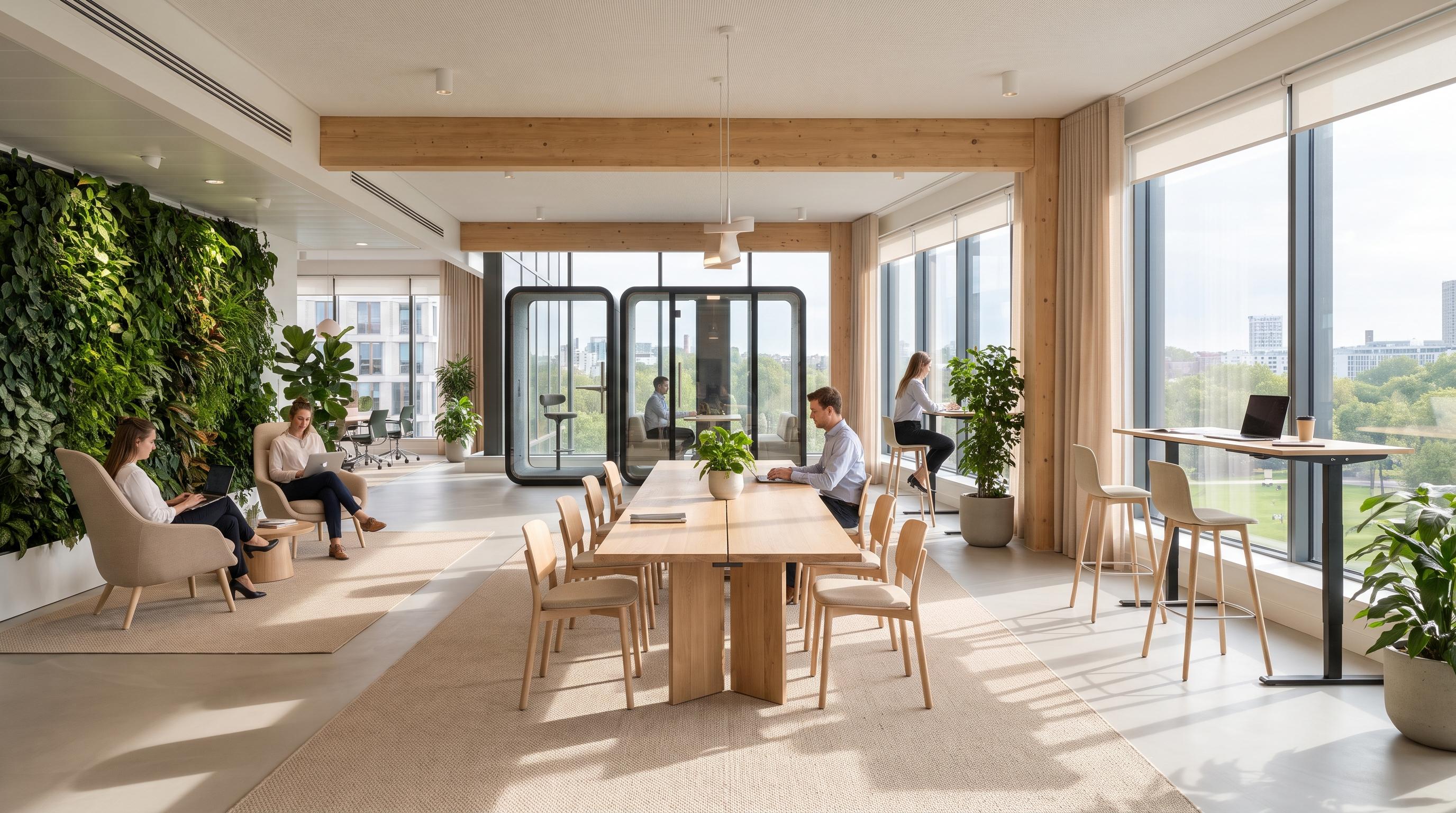
Most workplaces are designed to look productive, not to support real work
A workplace people can actually work well in protects focus, supports collaboration without constant spillover, and gives people enough comfort and choice to stay effective across the day. In practice, that means quieter focus settings, legible movement, steadier thermal and visual comfort, and spaces that let employees switch between solo work, team work, and recovery without friction.
When those basics are missing, even a stylish office starts to underperform. Teams say the office looks impressive, but they still struggle to find quiet when they need concentration. Meetings happen, but informal conversations spill into every zone. People come in for collaboration, then leave tired because the space offers too little acoustic relief, too little environmental comfort, and too little choice in how to work.
TL;DR: Better workplace design is not about making an office feel more current. It is about reducing daily friction for focused work, collaboration, movement, and recovery. The strongest offices outperform generic open-plan thinking by giving people clearer work modes, better comfort, and a more usable day-to-day experience.
That point is becoming easier to defend with evidence. Gensler’s 2024 Global Workplace Survey covered 16,040 full-time office workers across 15 countries, and JLL’s 2024 workplace research says acoustics, thermal comfort, and space for individual work are still among the weakest-rated workplace factors in many offices.
What a well-working workplace actually does
A well-designed workplace supports different kinds of work across a single day. It does not force every task into the same setting.
It gives focused work a real home, not just leftover corners.
It makes collaboration easy without making the whole floor noisy.
It helps people move intuitively, without confusion or wasted time.
It offers moments of pause, recovery, and visual relief.
It supports dignity and comfort across different ages, sensitivities, and working styles.
It feels energizing when energy is needed and calming when calm is needed.
In other words, the office should not behave like one giant open setting. It should behave like a balanced ecosystem of work modes.
Why so many offices underperform in daily life
Most workplace problems come from stacks of smaller design decisions, not one dramatic mistake. Those decisions make the day harder than it needs to be.
1. Acoustic comfort is treated as a finishing issue
Acoustics shape concentration, stress, speech privacy, and meeting quality. JLL’s 2024 workplace research says acoustics, thermal comfort, and space for individual work are commonly the weakest-rated factors in many offices. Leesman’s 2024 hybrid workplace analysis adds a sharper productivity signal: 80% of employees in outstanding workplaces say their workplace enables productivity, versus 65% in average workplaces. In the same analysis, private conversations, confidential discussions, and focused thinking score 17–20 points higher in stronger workplaces.
2. The layout over-prioritizes openness
Open space can support visibility and interaction, but too much openness removes control. When people cannot choose between quiet, semi-social, and collaborative settings, the workplace becomes tiring even when it looks generous.
3. Focus work is assumed to happen elsewhere
Hybrid work changed expectations, but it did not eliminate the need for concentration in the office. Gensler’s 2024 survey shows people still work across five modes: working alone, working with others in person, working with others virtually, learning, and socializing. A workplace that only supports meetings is not responding to how people actually work.
4. Environmental comfort is inconsistent
Lighting, glare, temperature, air quality, and access to daylight all influence whether people feel alert, calm, and able to stay engaged. If comfort changes wildly across the floor, employees begin adapting themselves to the building instead of the building supporting them.
5. Social space is mistaken for workplace culture
Social energy matters, but it is not the whole brief. People return to offices for connection, informal exchange, and team cohesion. They still need boundaries, legibility, and moments of retreat. A workplace that offers only buzz quickly becomes fatiguing.
The strongest offices support multiple work modes, not one design ideology
High-performing workplaces are built around variety. The question is not whether a workplace should be open or enclosed, collaborative or quiet, formal or lounge-like. The better question is whether it gives people enough choice to match the task in front of them.
That usually means designing for at least five conditions within the same environment.
Focused work: quiet rooms, enclosed booths, acoustically protected desks, or visually shielded settings for concentration.
Team collaboration: meeting settings sized to actual team behaviour, not only formal conference formats.
Informal connection: lounges, pantry zones, touchdown spaces, and social edges where spontaneous interaction can happen naturally.
Learning and reflection: spaces for mentoring, reading, review, or decompression between intense tasks.
Recovery: access to daylight, greenery, softer settings, and moments of relief that reduce cognitive fatigue across the day.
When these modes are planned intentionally, employees spend less energy working around the workplace and more energy using it well.
What research keeps confirming
The broader direction is clear: better workplaces are people-first workplaces.
Gensler’s 2024 survey argues that workplace performance is no longer only about efficiency or occupancy. It is also about how people feel in the space and whether the environment supports individual, team, and business outcomes. That shift matters because it brings emotional response back into the performance conversation where it belongs.
JLL’s 2024 workplace research makes the point even more directly. Many offices are still underperforming on acoustics, thermal comfort, and space for individual work, even though those are some of the conditions most closely tied to productivity and wellbeing. The implication is straightforward: if the environmental basics are weak, visual upgrades alone will not fix workplace performance.
Leesman’s 2024 analysis adds an important hybrid-work insight. Across more than 305,000 employees surveyed globally, 86% said they work in more than one location, while only 9% work only in the office and 5% are fully remote. That matters because today’s office has to earn its role. It cannot assume people will tolerate friction just because the lease exists.
This is also where this article can differ from generic search results. Many top-of-funnel workplace pieces repeat the same open-versus-hybrid argument. A more useful lens is to review the office through lived experience: how the space handles focus, movement, comfort, recovery, and emotional ease on an ordinary Wednesday afternoon.
A more useful lens: design for focus, belonging, reward, barriers, and safety
At Happy Spaces, we find it more useful to evaluate workplaces through practical human outcomes rather than style categories alone. You can explore the wider thinking behind this on the Happy Space Framework page and browse related design levers in Places.
Nature’s Pampering
Does the workplace feel restorative at any point in the day? Daylight, views, planting, fresh air, and softer material choices can reduce mental fatigue and make long hours feel less depleting.
Belongingness
Does the space support different personalities, roles, and work styles? A workplace should not only suit the loudest, most extroverted, or most senior users. It should feel usable and welcoming across a wider range of people.
Reward
Does the workplace offer emotional uplift? That might come from a calm window-side setting, a beautifully handled arrival, a comfortable team lounge, or simply the feeling that the organisation cared enough to make work easier.
Barriers
Acoustic spill: background conversation, reverberation, and speech leakage that reduce focus.
Glare and uneven lighting: conditions that increase fatigue and make concentrated work harder.
Awkward circulation and zoning: layouts that make movement confusing and interruptions more likely.
Insufficient privacy: too few places for calls, confidential conversations, or solo thinking.
Rigid furniture setups: settings that cannot flex between individual work, quick chats, and team work.
Safety
Does the workplace feel legible, stable, and low-stress? Safety is not only about compliance. It is also about whether people can move easily, find what they need, avoid unnecessary exposure, and feel physically and psychologically at ease.
When teams review workplaces through these five lenses, the conversation becomes more practical. It moves away from abstract trends and toward whether the space is actually helping people work better.
Questions to ask before signing off on a workplace design
A workplace can look complete on drawings and still underperform in reality. These are the questions worth asking before final decisions are locked.
Where can someone do 45 minutes of focused work without interruption?
Where can two people have a quick conversation without disturbing six others?
Does the layout make movement intuitive for new users and visitors?
Are there enough settings for both collaboration and decompression?
How do acoustics, temperature, and glare change across the day?
Does the workplace support different working styles, sensitivities, and energy levels?
Would employees still value this office if the styling were simplified and only lived experience remained?
Those questions usually reveal more than a mood board can.
The business case is stronger than it looks
Workplace design is not only a culture issue. It is also an operational lever.
When people cannot concentrate, recover, or collaborate smoothly, the cost shows up in slower work, meeting spillover, irritation, fatigue, and weaker engagement with the office itself. On the other hand, when a workplace supports real work modes well, it can strengthen team connection, improve the quality of time spent on site, and make the office feel worth returning to.
That matters for employers trying to attract talent, support hybrid routines, and justify investment in space. The best workplaces do not force attendance through policy alone. They create environments that people find easier, more useful, and more human to work in.
If you are planning a new office or repositioning an existing workplace, review it through lived experience as well as layout. That is where better performance usually begins.
Key takeaways
Protect focus first: if concentration is hard, the office will feel harder to justify.
Design for several work modes: one open setting cannot carry every task well.
Comfort is performance infrastructure: acoustics, temperature, daylight, and glare are not cosmetic issues.
Generic workplace trends are not enough: lived experience is a better design test than style language.
Better workplaces earn return visits: people come back when the environment helps them work well, not when it only looks impressive.
Ready to review a workplace through lived experience? Start a conversation with Happy Spaces to assess how focus, comfort, circulation, and recovery are shaping day-to-day performance.
Frequently asked questions
What makes a workplace genuinely productive?
A productive workplace supports more than one kind of work. It makes room for concentration, collaboration, informal connection, and recovery, while keeping environmental friction low.
Why do many modern offices still feel hard to work in?
Because visual openness and contemporary styling do not automatically create good working conditions. Weak acoustics, glare, limited privacy, and poor task-fit often make daily work harder even in attractive offices.
How important are acoustics in workplace design?
They are central. Acoustic comfort affects concentration, stress, speech privacy, and meeting quality, which means it shapes both performance and wellbeing throughout the day.
Should offices now be designed mainly for collaboration?
No. Collaboration matters, but workplaces still need to support focused individual work, learning, reflection, and decompression. Offices work best when they support multiple work modes rather than one dominant setting.
How should workplace design be reviewed before sign-off?
A better review looks at lived experience, not only plans or styling. Teams should test whether people can focus, move intuitively, hold quick conversations without disturbance, recover from cognitive fatigue, and feel comfortable across the full working day.